CTO, Chief Architect
Engineering a Portable API Platform for Complex Multi-Service Products
M360API was built on one belief: modernization should protect prior investment, not destroy it. Deploy it beside legacy, extend what works, and evolve toward modern architecture at your own pace.
Projects>M360API
M360API
A modernization platform that lets companies extend legacy systems without discarding years of engineering investment.
As distributed systems became the norm, many teams were blocked by a hard truth: they needed modernization, but they had too much invested in legacy systems to replace everything.
I led the architecture and product strategy for M360API to solve exactly that tension: deploy next to existing platforms, introduce modern runtime controls, and modernize without business disruption.
The result was a portable, modular operating model that lets organizations preserve legacy value while building new systems with modern stacks, languages, and service boundaries.
Challenge Landscape
- Modernize organizations that could not afford to throw legacy investments away.
- Introduce new architecture capabilities without forcing a full rebuild from scratch.
- Support mixed languages and technology generations in one operational model.
- Deliver multi-tenancy, security, and traffic control without heavy migration overhead.
- Enable teams to build new systems on modern stacks while legacy workloads remain active.
Core Platform Components
API Gateway
A portable, multi-tenant gateway built to solve integration between frontend channels and backend components.
It removes repetitive infrastructure layers engineers usually rebuild in every service, so teams focus on business logic.
The gateway standardizes communication across microservices written in different technologies and applies configurable security controls.
It injects multitenancy context into incoming requests before handing off to service APIs.
Middleware
An open-source, multi-technology SDK installed inside services running behind the gateway.
It interprets the context injected by the gateway and augments APIs with tenant-aware behavior without code revamps.
It loads registry-driven runtime configuration so teams avoid hard-coded settings for databases, sessions, mail, and CORS.
This enables dynamic, configuration-driven systems that can change behavior safely across environments.
Console
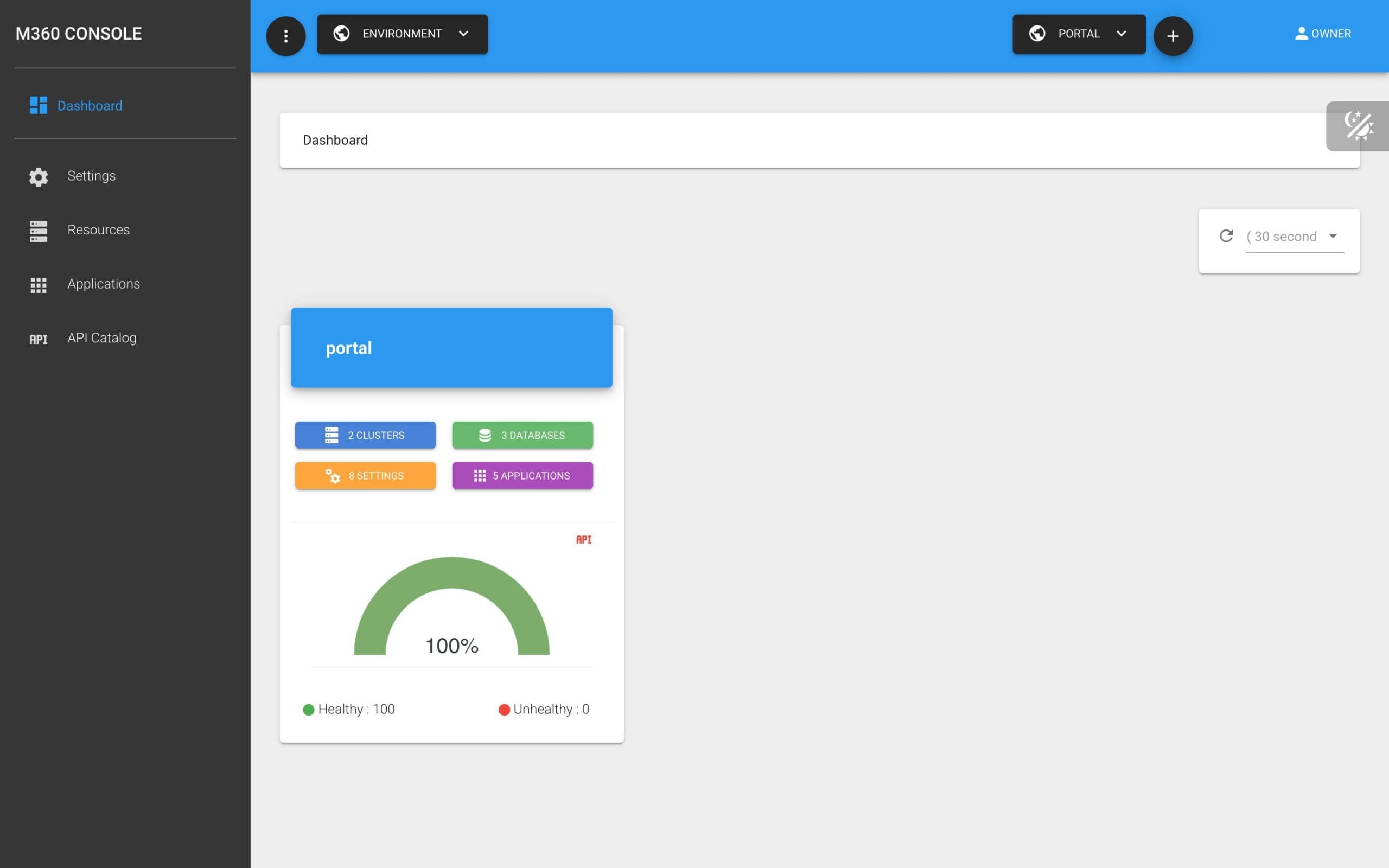
A multi-environment control plane used to configure, monitor, and operate deployed systems.
It includes guided workflows for environment setup, resource wiring, access control, deployment, and troubleshooting.
The API Builder generates microservices preconfigured with M360 middleware in multiple programming languages.
One console instance can manage many environments and remains portable on Linux-based infrastructure.
M360 SaaS Version
M360 SAAS showing the gateway, middleware all controlled from SAAS dashboard.
Advantages
- Performance boost since all components are running on the same hosting platform of the customer.
- Reduced security breaches and attacks since components are on the same network and share information internally.
- Cloud-provider-agnostic solution that runs with any cloud provider (no more siloing).
- Technology-agnostic communication through M360 middleware across several programming languages.
- Portability: out of the box, M360 Gateway can run anywhere.
- Manage all components in all environments from the same location; SaaS platform (red connectors).
SaaS Example - Legacy Modernization
Example using M360 to extend a legacy CMS via gateway and microservice without a full revamp.
Highlights
- This marketplace is composed of several internal components where each component handles different request types.
- The order manager processes payments and generates orders, built with PHP and operating on a MySQL database.
- The product catalog handles browsing, cataloging, product search, and related features, built with Node.js and operating on an Elasticsearch database.
- The M360 Gateway handles traffic management, authentication, authorization, user sessions, registry configuration sharing, multitenancy, and versioning.
- The M360 Middleware interprets gateway exchanges with components and facilitates data exchange.
- The M360 Console lets customers operate, manage, and configure gateway settings in all environments using the same user interface.
- Cloud configuration, security credentials, tokens, and other sensitive data are stored in a separate database accessible only by the Gateway through a separate private secure connection.
SaaS Example - Commerce Integration
Example using M360 for commerce, integrating catalog, ordering, payment providers, and shared runtime controls.
Highlights
- M360 can be deployed next to a legacy application and facilitate extending the application by bridging to existing features.
- New features can be added in newly created systems without any revamp in the existing legacy application and its code.
- Staff continue to operate on the legacy app as they are used to, while the frontend talks to the M360 Gateway and it knows what to do.
- Cloud configuration, security credentials, tokens, and other sensitive data are stored in a separate database that is only accessible by the Gateway via a separate private secure connection.
M360 Enterprise Version
M360 Enterprise showing where platform components are deployed inside customer-managed infrastructure.
Advantages
- Performance boost since all components are running on the same hosting platform of the customer.
- Reduced security breaches and attacks since components are on the same network and share information internally.
- Cloud-provider-agnostic solution that runs with any cloud provider (no more siloing).
- Technology-agnostic communication through M360 middleware across several programming languages.
- Portability: out of the box, M360 Gateway can run anywhere.
- Native support for on-premise solutions and hybrid deployments without any refactoring or workaround.
- One license for unlimited projects (red dotted connectors).
- Manage all components in all environments from the same UI Console (red connectors).
Enterprise Example - Hybrid Deployment
Example using M360 Enterprise in a hybrid model across cloud and on-premise environments with shared control.
Advantages
- Performance boost since all components are running on the same hosting platform of the customer.
- Reduced security breaches and attacks since components are on the same network and share information internally.
- Cloud-provider-agnostic solution that runs with any cloud provider (no more siloing).
- Technology-agnostic communication through M360 middleware across several programming languages.
- Portability: out of the box, M360 Gateway can run anywhere.
- Native support for on-premise solutions and hybrid deployments without any refactoring or workaround.
- One license for unlimited projects (red dotted connectors).
- Manage all components in all environments from the same UI Console (red connectors).
- Hybrid deployments supported where one environment is hosted on the cloud (blue box) and the other is on premise (orange box).
Strategic Response
- Built M360API as a portable API modernization platform composed of three integrated products.
- Deployed it next to legacy systems so customers could extend what already existed instead of shelving it.
- Added platform-level capabilities including multitenancy, traffic management, security, and scalability.
- Enabled incremental adoption so teams can keep legacy stable while building new services on modern tech stacks.
Key Architectural Decisions
- Designed M360API as a lightweight, portable platform deployed next to legacy systems.
- Introduced multi-tenancy, traffic management, security, and scalability as shared platform capabilities.
- Enabled decentralized service evolution with standardized runtime behavior through gateway and middleware.
- Created an integration-first model that allows legacy and modern stacks to operate together during transformation.
Measured Impact
- Allowed customers to preserve and extend existing systems instead of replacing them.
- Reduced modernization risk by enabling side-by-side deployment with legacy environments.
- Unlocked migration from old programming-language constraints to modern polyglot service architectures.
- Delivered enterprise-grade governance and scalability without a disruptive full-platform rewrite.
If your business is trapped between legacy investment and modernization pressure, I design the platform strategy that lets you keep what works and evolve into modern architecture without starting over.