Architect, Technical Lead
From Fragile Monolith to Scalable Ad-Tech Engine in Months
This was a legacy modernization under pressure: take a promising but fragile system and turn it into a platform that could launch, scale, and absorb complexity without collapsing.
Projects>Spread Content Platform
Spread Content Platform
A legacy-leaning ad-tech concept re-engineered into a launch-ready, integration-heavy SaaS platform for the MENA market.
Spread, part of the Choueiri Group network, had strong business potential but an architecture that could not safely support its product ambition.
I joined in Q2 2020 and led the modernization strategy: break the monolith, redesign service boundaries, and introduce gateway-centric operational control.
With a small engineering team, we executed the transformation fast, launched confidently, and replaced technical fragility with a scalable, evolvable operating model.
Challenge Landscape
- The original Laravel proof of concept was too rigid for an integration-heavy production future.
- AI requirements demanded Python while other domains required NodeJs and PHP in parallel.
- A legacy accounting core without API support required custom bridge services.
- Payment rails differed by country, processor, currency, and workflow, requiring dynamic provider logic.
- Notification delivery had to support interchangeable email and SMS providers without rewrites.
- A centralized identity, role, and permission model was mandatory across distributed services.
Core Platform Components
Stage 1 - Rewrite the Core
Frontend channels were detached from the monolith and rebuilt with VueJS for clean API-first interaction.
Backend capabilities were decomposed into focused services aligned to business domains and integration boundaries.
This phase removed the largest structural bottlenecks and enabled controlled scaling of the product.
Stage 2 - Introduce Platform Control
The API Gateway became the single controlled ingress layer for all application traffic.
M360 middleware standardized runtime context handling and multitenancy behavior across services.
Authorization, security, traffic management, and cloud-awareness moved from ad-hoc code to architecture policy.
Resulting Operating Model
Gateway-enriched requests created a common communication contract across all service technologies.
Teams could evolve AI, integration, and business services independently without protocol chaos.
Engineering effort shifted from re-implementing infrastructure concerns to shipping business value.
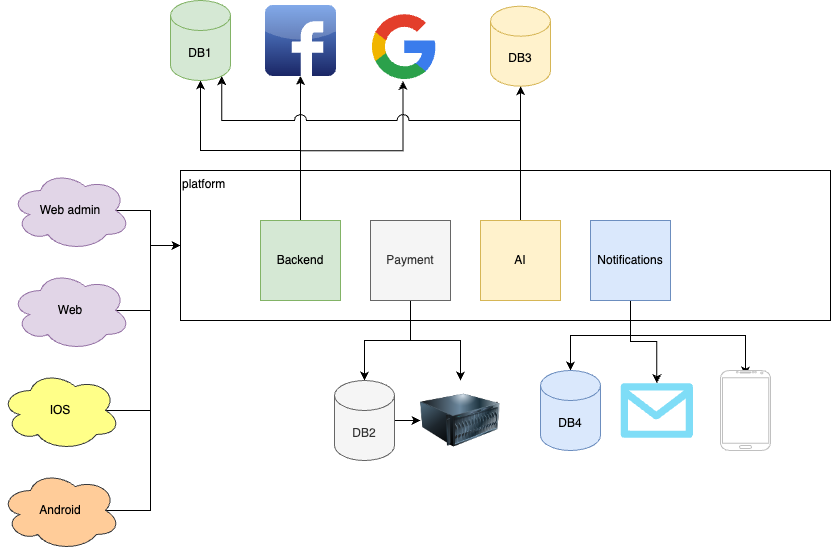
Monolith to Microservices Conversion
This diagram shows how the original Laravel monolith was decomposed into coordinated microservices with separated responsibilities and cleaner integration boundaries.
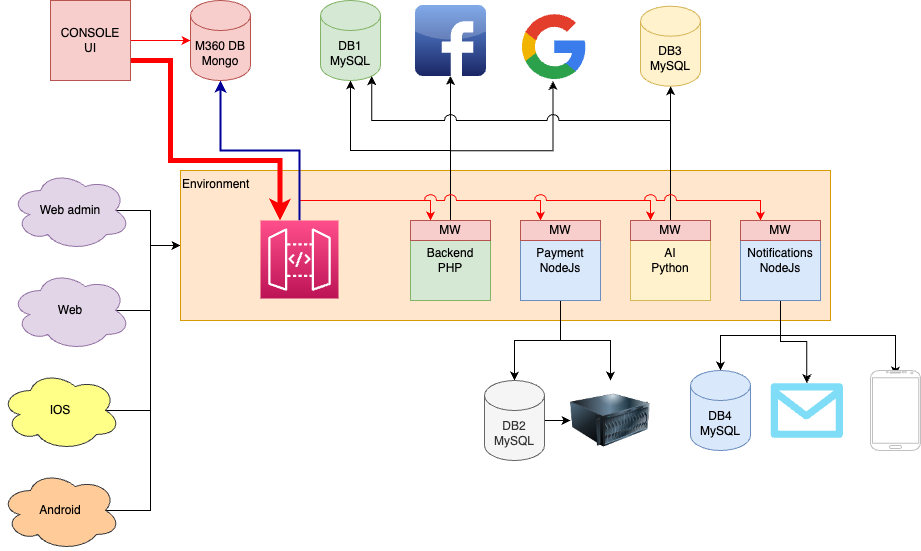
M360API with the New Microservices
This diagram shows how M360API was positioned on top of the newly created microservices, with the API Gateway and middleware orchestrating secure, standardized, multi-tenant request flow.
Strategic Response
- Executed a decisive two-stage transformation from monolith to service-oriented architecture.
- Rebuilt frontend channels with VueJS and severed tight coupling with backend internals.
- Installed M360API Gateway + middleware as shared architecture primitives, not optional add-ons.
- Forced all incoming traffic through a controlled gateway path for security, context enrichment, and consistency.
- Enabled polyglot service development while enforcing one communication and governance model.
Platform Evolution Timeline
Stage 1 - Structural Rewrite
Decoupled interfaces from the monolith, rebuilt frontend delivery with VueJS, and split backend into focused services with clear ownership and operational boundaries.
Stage 2 - Platform Hardening with M360API
Placed M360API at the heart of runtime operations: gateway-driven control, middleware-based context propagation, and standardized security and multitenancy behavior.
Key Architectural Decisions
- Decomposed backend from monolith into coordinated microservices.
- Introduced M360 API Gateway as centralized traffic, security, and multitenancy entry point.
- Used middleware layer to standardize service communication across PHP, NodeJs, and Python components.
- Implemented integration-ready boundaries for payments, notifications, legacy accounting, and ad-platform connectivity.
Measured Impact
- Moved from constrained monolithic architecture to a production-ready microservices operating model.
- Delivered modernization and launch trajectory in about four months with a lean engineering team.
- Enabled expansion beyond Google-centric workflows to multi-platform ad distribution.
- Created a resilient base for AI-driven operations, regional scaling, and future feature velocity.
If your product is trapped in legacy constraints, I architect and lead the modernization path that turns technical debt into a launch-ready, scalable platform.